
community

Watertower Rising: The Nuckolls Legacy Now Available as a Touring Pocketbook

In the heart of Pueblo, Colorado, stands a remarkable structure: a 250,000-square-foot industrial landmark once known as the Nuckolls Packing Company. Founded in 1890 by Emmet Nuckolls after a successful run in Leadville, the company transformed over three generations into one of America’s most advanced and respected meatpacking enterprises.
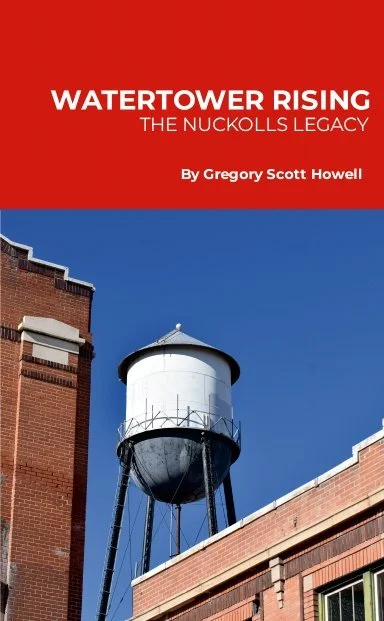
This book chronicles that extraordinary journey. From modest beginnings at the Union Stockyards to the construction of the world's most modern meat processing facility, the story of the Nuckolls family is one of innovation, ambition, and resilience. Readers will meet GH Nuckolls, the founder’s son, whose collaboration with Norwegian engineer Hans Peter Henschien helped revolutionize the meat industry. Influenced by the 1906 Pure Food and Drug Act, they built a gravity-driven, multistory plant that prioritized hygiene, worker safety, and operational efficiency.

But this is more than the story of a business. It is a story of leadership through adversity. The Great Pueblo Flood of 1921, the Great Depression, and the shutdown during World War II all tested the company’s endurance. After GH Nuckolls' passing, the leadership baton was taken up by his daughters, Della and Marion Nuckolls. Though few women held top positions in American industry at the time, these sisters brought determination and vision to the company. Marion became president. Della, who studied under the Denishawn School in Los Angeles and performed on Broadway, balanced an artistic life with her role as vice president and treasurer.

The book also shares Della’s remarkable life on stage, her multiple marriages, and her steadfast connection to Pueblo. Through newly discovered letters, rare photographs, and original documents, the narrative offers a deeply human look at how one family helped shape an entire industry.

In the years that followed, the company was sold to American Stores and later supplied meat across the Southwest. Operations ceased in 1980, but the story was far from over. In the early 2000s, entrepreneur Ryan McWilliams purchased the dormant facility and launched Watertower Place, a creative center for commerce, culture, and community.

This book is a tribute to the people, places, and power of legacy. It reminds us that the past is never lost. It is waiting to be remembered, reimagined, and shared.

To learn more, visit:
www.gregoryhowell.com
www.pueblowatertowerplace.com
The Story Behind Shores of Pueblo

The Story Behind Shores of Pueblo

For 15 years I have walked the river in Pueblo and asked a simple question:

How did we get here?

Not just economically.
Not just politically.
But culturally. Spiritually. Collectively.

Pueblo is a place that carries memory in layers. The river valley holds stories that began long before state lines or rail lines. Steel mills reshaped the skyline. Floods reshaped the land. Immigration reshaped identity. Industry reshaped opportunity. And yet through every transformation, something essential endured.

That endurance is what this project is about.

Why Twelve Chapters

Time moves in cycles. Twelve months. Twelve seasons of reflection. Twelve opportunities to pause and listen.

Rather than publish a single book all at once, I chose to release Shores of Pueblo chapter by chapter over the course of a year. Each month, one story. Each story rooted in a different era. Each era told through a human voice standing inside its moment, not looking back with hindsight, but living forward with uncertainty.

The goal is not nostalgia.

The goal is preparation.

If we understand the people who stood at these shores before us — the First Peoples of the river valley, the early Spanish borderlands, railroad builders, steelworkers, farmers, labor organizers, immigrants, artists, civic leaders, and everyday neighbors — then we begin to see patterns. We begin to see resilience. We begin to see warning signs. We begin to see possibility.

The world always changes.
But the stories stay.

Why Launch Through the Pueblo Star Journal

I co-founded the Pueblo Star Journal in 2021 because I believe local storytelling is a public good.

Before these chapters live as a book, they live as journalism — accessible, shared, and rooted in community conversation. By publishing each chapter first in the PSJ, the stories remain what they were meant to be: communal.

They are not artifacts.

They are invitations.

An invitation to read.
An invitation to remember.
An invitation to ask better questions about where we are going.

The flyer for the 2026 series calls this “Walking the stories that made us” GH 2026 12 CHAPTER PUEBLO STORY…. That phrase matters to me. These are not abstract histories. They are footsteps. Decisions. Turning points.

And we are still walking.

The North Star

Every chapter carries the same thread:

When we listen and remember the stories, we will be prepared for whatever comes.

Preparation does not mean control. It means awareness. It means humility. It means understanding that borders are rarely lines — they are collisions of stories.

Pueblo has lived through borderlands, industry booms, economic collapse, natural disaster, civic reinvention, and cultural renaissance. We are still evolving.

This series is not about proving anything.
It is about listening long enough to recognize ourselves.

An Ongoing Conversation

Each chapter will be released monthly. Each one will stand on its own. Together, they form a year inside the soul of Pueblo.

If you choose to follow along, I invite you to do more than read.

Ask your elders what they remember.
Walk the river.
Stand in places where something once began.
Listen.

Because the world will continue to change.

But if we know the stories, we will know how to walk through whatever comes.

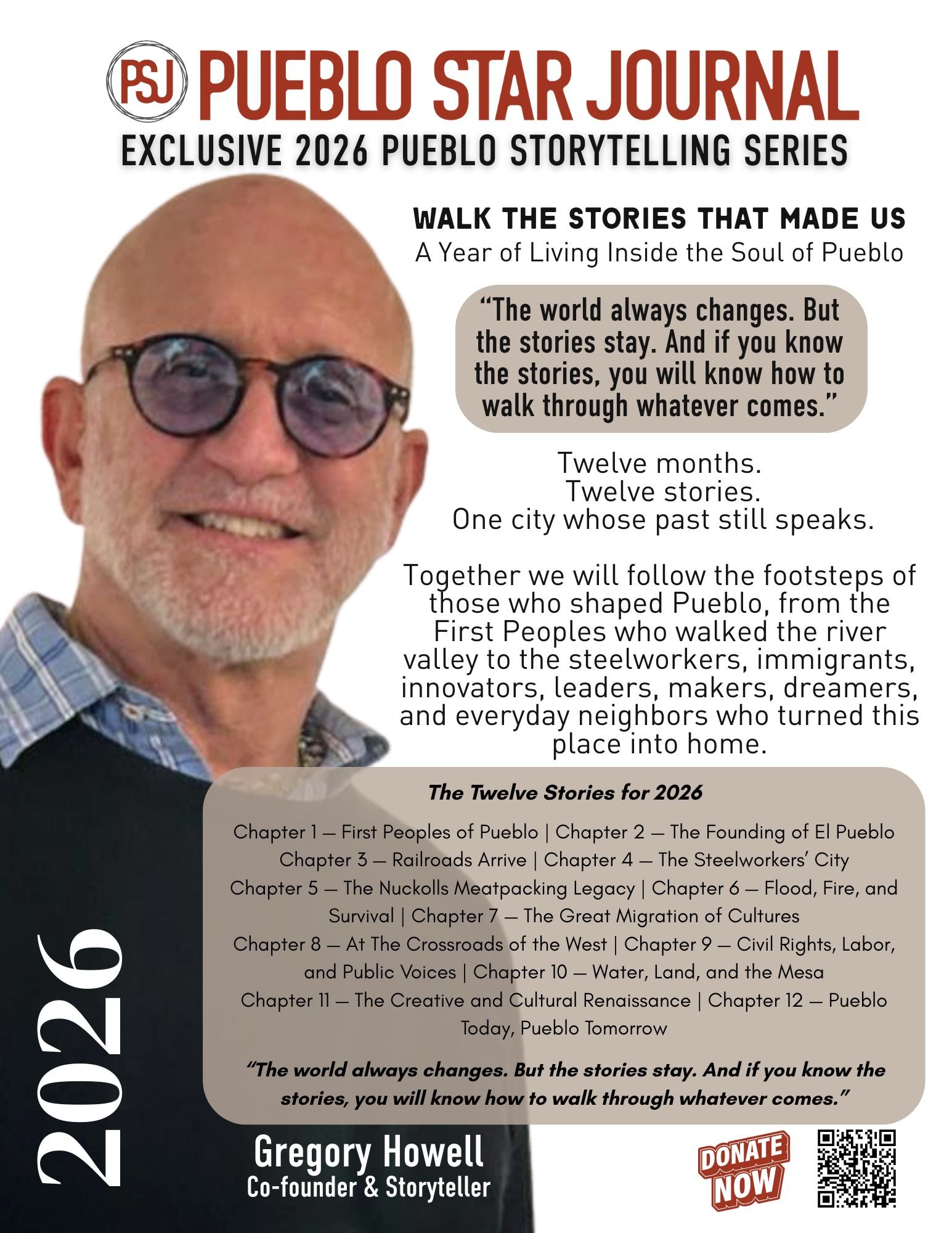
Gregory Howell

The Journey of Intersection | Zen Buddhism and Quantum Physics

This abstract expressionist painting, chosen as the cover of this book, serves as a metaphor for the interconnectedness explored within its pages. Its intricate layers and vibrant patterns evoke a sense of boundless possibility—whether imagined as the vast cosmos or the glowing fabric of a city at night, it speaks to the infinite intersections of Zen Buddhism, quantum physics, and the human experience. Special thanks to Maggie Watson of Pueblo, Colorado for making this painting available.

Introduction: The Journey of Intersection

When I was just five or six years old, I would often sit in the den of my childhood home, spinning a globe that rested on the bookshelf. As the globe slowed, my finger would trace its surface until it stopped. More often than not, it landed on the same place: Japan. Something about this small island nation captured my imagination. I pulled out the books that lined the shelves—volumes of the Encyclopedia Britannica, Time Life books, and other encyclopedias. The images of ancient temples, samurai armor, and serene gardens enthralled me. Even at that young age, I was drawn to a world steeped in tradition, ritual, and a deep sense of beauty.

The fascination didn’t stop at books. I became mesmerized by traditional Japanese clothing, the patterns and folds of the kimono, and the artistry of the obi. My fifth-grade teacher—a retired flight attendant who had traveled extensively to Japan—brought that world into our classroom one day when she wore a kimono. I still remember how transformative that moment felt. It was as if the colorful garment bridged a gap between the mundane and the extraordinary. I knew then that Japan was a place I needed to experience for myself.

Early Fascinations: Culture, Art, and Space

Speed Racer and Kimba the White Lion were some of my early ambassadors of Japanese culture as my interest in Japan started to grow. Photo: Speed Racer Enterprises Inc 1967.

My interest expanded as I grew. Television shows like Speed Racer and Kimba the White Lion introduced me to Japanese storytelling, a world of heroism and emotional complexity that felt different from the cartoons I was used to. I tried every Japanese food I could find, savoring the unfamiliar flavors and textures. By my early teens, my fascination had become a full-fledged passion. When the opportunity arose to travel to Japan and live with a homestay family, I didn’t hesitate.

That trip was life-changing. For the first time, I immersed myself in a culture that viewed the world differently from my own. I learned daily conversational Japanese and the hiragana and katakana alphabets. The Kanji, Chinese characters adopted into Japanese, captivated me as an artist—they were not just words but ideographs, each with a story and essence of its own.

One of my most profound realizations came in Tokyo. From the window of my host family’s home, I could see Tokyo Tower in the distance. It seemed close enough to walk to, so I did. When I told my host family that I had walked to and from the tower, they were astonished. To them, it was unimaginable that someone would make such a trek on foot. It was then I began to understand that our conceptualizations of space and distance are deeply cultural.

Another moment of clarity came aboard Tokyo’s crowded trains during rush hour. Packed shoulder-to-shoulder with strangers, I noticed how the typical discomfort of personal space didn’t apply. There was no pushing, no complaints. Everyone accepted the closeness as part of the social contract. I compared this to the invisible “square box” of personal space in the United States. In Japan, the closeness of strangers did not threaten individuality; instead, it dissolved into collective harmony.

Lessons in Harmony and Hierarchy

My time in Japan taught me not only about space but also about the structure of relationships. I observed the intricate sempai-kohai dynamic, the respect and responsibility between teacher and student, senior and junior members of society. Group harmony, or ‘wa’, was paramount. No one wanted to let others lose face, a stark contrast to the individualism emphasized in the West. These early lessons in interconnectedness became a foundation for my later studies of Zen and its deep exploration of relational dynamics and harmony.

This experience was more than cultural immersion—it was a lens through which I began to see the world. The principles I observed during my teenage years resonated with my growing curiosity about life’s deeper questions. How do we find balance in a world full of contradictions? How do we exist as individuals while being part of a larger whole? These questions would remain with me through my academic and professional pursuits.

Academic Explorations: A Path Toward Understanding

At the University of California at Berkeley, my classes in the East Asian Studies Department were enriched by my famous scholarly advisors, Robert Scalapino and Chalmers Johnson. My undergraduate thesis, Zaibatsu Rationalization through Zaibatsu Dissolution, explored how the U.S. dismantled Japan’s powerful industrial conglomerates after World War II. It was a deep dive into the intersection of economics, politics, and cultural resilience.

Later, as a graduate student at Cornell University, I studied under Eleanor Jordan, a pioneer in Japanese language education. My master’s thesis under the advisement of anthropologist Robert J. Smith, Part-Time Farmers and Rice Production in Japan: Manifestations of the Legacy of Postwar Agricultural Policy, delved into the intricate relationship between tradition and modernity in Japan’s agricultural sector. These projects required not just critical thinking but also an ability to synthesize cultural, historical, and philosophical perspectives—skills that would serve me well in my lifelong exploration of Japan.

Professional Engagement: Bridging Cultures

After completing my graduate studies, I was accepted in the Japanese Exchange and Teaching Program (JET) as a Coordinator for International Relations (CIR). Assigned to the City of Yokohama, I worked in the International Design Section of the Urban Planning Department, where I contributed to projects aimed at fostering cross-cultural understanding. This role deepened my appreciation for Japan’s group-oriented society and its balance of innovation and tradition.

Returning to the United States, I co-founded the JET Alumni Association of Northern California (JETAANC), a network that has grown into a vibrant community. Over the years, my contributions to U.S.-Japan relations earned recognition, including the Japan Foreign Minister’s Commendation in 2006. These milestones are not just professional achievements—they are expressions of my ongoing commitment to the values and ideas that Japan embodies.

Interconnectedness Across Generations

My grandfather Clifton Lessing traveling the waterways in Japan in 1963 with camera in hand.

In 1963, just one year after my birth, my grandfather, Clifton Lessing, traveled to Japan as part of his work as an aerospace mechanic for a government contractor. He was a man of Northern German roots, whose English was not entirely smooth, but he possessed an incredible ability to tell stories—stories not through words, but through the lens of his camera.

Clifton was an amateur filmmaker and photographer, capturing life’s quiet moments and the unspoken narratives of people going about their daily lives. His photos, like the ones he took during his trip to Japan, are striking in their simplicity. They remind us of the interconnectedness of all human activity: the shared gestures, the familiar rhythms of life, and the subtle beauty of ordinary existence.

Traditional Japanese residence with two floors with tile atop the roof and ovrt the porch. Photo by Clifton Lessing 1963.

Tea growing in perfectly manicured rows of evergreen shrubs. Photo by Clifton Lessing 1963.

One of his photographs shows a modest Japanese home nestled among fields, embodying the timeless spirit of Japan’s rural landscape. Another captures the meticulous rows of a tea field, a testament to human care and harmony with nature. These images are a reflection of my grandfather’s fascination with life as it unfolds naturally—unscripted and honest.

What is deeply meaningful to me is the unspoken connection between my grandfather’s journey to Japan and my own path. His visit, just a year after my birth, feels almost like the planting of a seed—a moment that subtly influenced the trajectory of my life. Years later, I found myself immersed in Japanese culture, language, and traditions, making Japan a central part of who I am. In a way, my grandfather’s lens and my journey intersect, creating a bridge across generations and geographies.

This connection reminds me of the Zen concept of ensō, the hand-drawn circle that symbolizes enlightenment, the universe, and the interconnectedness of all things. Life, much like the ensō, is cyclical—unfolding in ways we cannot always see but can deeply feel.

Enso paintings by Gregory Howell in 1990.

Zen and Quantum Physics: The Intersection Unveiled

The famous Ryoanji Zen rock garden in Kyoto, Japan. The meticulously raked sea of stone gravel contains a total of 15 rocks which are placed as a single stone or as a cluster of multiple stones with a carpet of moss. No matter where you sit around the rock garden, you cannot see all 15 stones as some are hidden as you move around the garden —- the intentional design serves as its own unique koan or puzzle for contemplation. Photo by Gregory Howell in 2018.

Throughout my journey, one theme has remained constant: a fascination with how different systems of thought can converge to illuminate universal truths. This fascination crystallized in my recognition of the parallels between Zen Buddhism and Quantum Physics.

Zen, with its emphasis on interconnectedness, impermanence, and the dissolution of dualities, offers profound insights into how we perceive and interact with the world. Quantum Physics, with its exploration of entanglement, uncertainty, and the wave-particle duality, challenges our understanding of reality itself. At first glance, these disciplines might seem worlds apart—one rooted in ancient spirituality, the other in cutting-edge science. Yet, they both point to a universe that defies conventional logic and invites deeper inquiry.

From Curiosity to Clarity

Over the decades, my interest in Zen and Quantum Physics evolved from curiosity to clarity. The once-disconnected threads of my experiences, studies, and observations began to weave into a harmonious narrative. The cultural lessons I learned in Japan—about space, harmony, and interconnectedness—were not isolated insights. They were echoes of a larger truth, a truth that both Zen and Quantum Physics seek to uncover.

This book is the culmination of that journey. It is an exploration of how these two seemingly disparate fields converge to offer a new way of understanding ourselves and our place in the universe. It is also a practical guide, offering tools like the Tray of Life methodology to help readers apply these insights to their own lives. Over the years I have consistently asked three questions of my students, colleagues and clients:

Who am I?

What do I have to say?

Where am I going?

What appears to be a simple list of questions about oneself is actually a complex series of measures about where one exists in the universe at a given time and place. I ask these questions over and over, especially when confronted with new situations. Life throws us a variety of opportunities and challenges and it is this process of asking and answering these questions that we move from curiosity to clarity. 

A Call to the Reader

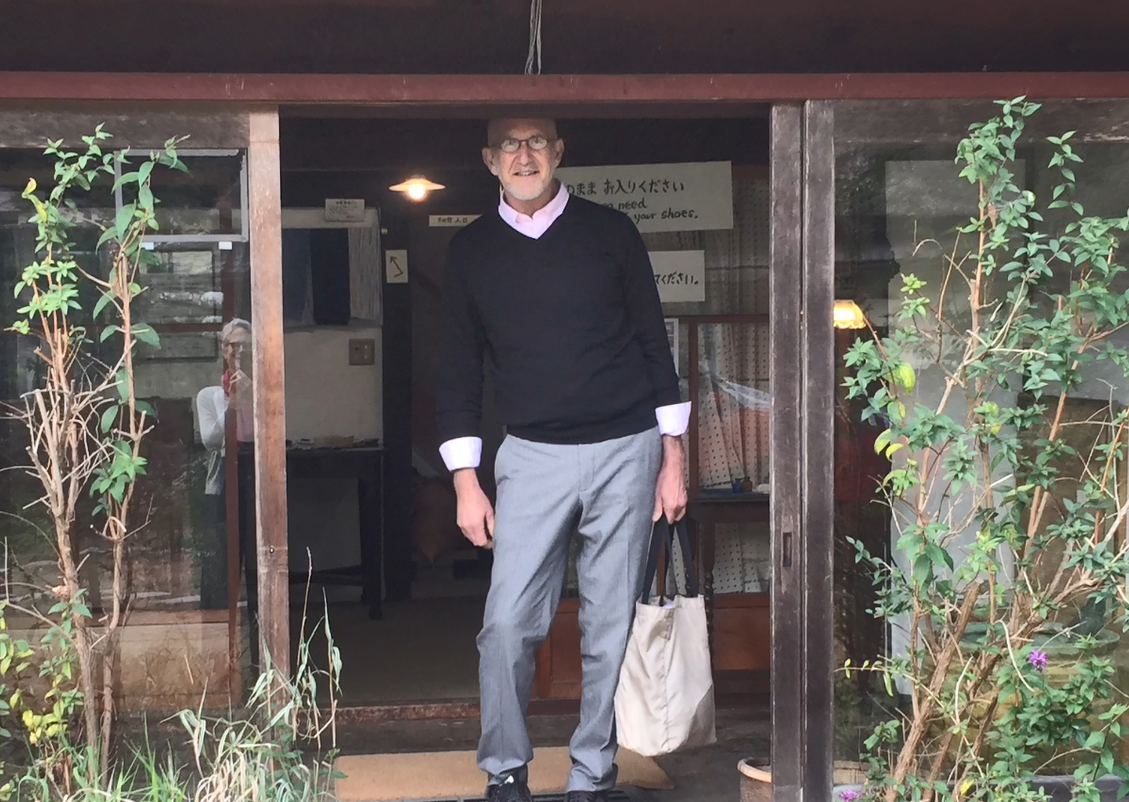
Gregory Howell exploring the world of indigo at rural studios and museums on the outskirts of Kyoto. 2018

In a world filled with complexity and division, I believe in the power of shared stories to bridge gaps and solve problems. The act of breaking bread, of coming together with open minds and hearts, has the potential to transform even the most daunting challenges. This book is not just about Zen or Quantum Physics—it is about finding clarity in the chaos, harmony in the dissonance, and unity in the diversity of human experience.

I invite you to join me on this journey. Whether you are a seasoned philosopher, a curious scientist, or someone seeking a fresh perspective, this book is for you. Together, let us explore the mysteries of existence and discover how the principles of Zen and Quantum Physics can illuminate our lives.

GH