
Pueblo

The Story Behind Shores of Pueblo

The Story Behind Shores of Pueblo

For 15 years I have walked the river in Pueblo and asked a simple question:

How did we get here?

Not just economically.
Not just politically.
But culturally. Spiritually. Collectively.

Pueblo is a place that carries memory in layers. The river valley holds stories that began long before state lines or rail lines. Steel mills reshaped the skyline. Floods reshaped the land. Immigration reshaped identity. Industry reshaped opportunity. And yet through every transformation, something essential endured.

That endurance is what this project is about.

Why Twelve Chapters

Time moves in cycles. Twelve months. Twelve seasons of reflection. Twelve opportunities to pause and listen.

Rather than publish a single book all at once, I chose to release Shores of Pueblo chapter by chapter over the course of a year. Each month, one story. Each story rooted in a different era. Each era told through a human voice standing inside its moment, not looking back with hindsight, but living forward with uncertainty.

The goal is not nostalgia.

The goal is preparation.

If we understand the people who stood at these shores before us — the First Peoples of the river valley, the early Spanish borderlands, railroad builders, steelworkers, farmers, labor organizers, immigrants, artists, civic leaders, and everyday neighbors — then we begin to see patterns. We begin to see resilience. We begin to see warning signs. We begin to see possibility.

The world always changes.
But the stories stay.

Why Launch Through the Pueblo Star Journal

I co-founded the Pueblo Star Journal in 2021 because I believe local storytelling is a public good.

Before these chapters live as a book, they live as journalism — accessible, shared, and rooted in community conversation. By publishing each chapter first in the PSJ, the stories remain what they were meant to be: communal.

They are not artifacts.

They are invitations.

An invitation to read.
An invitation to remember.
An invitation to ask better questions about where we are going.

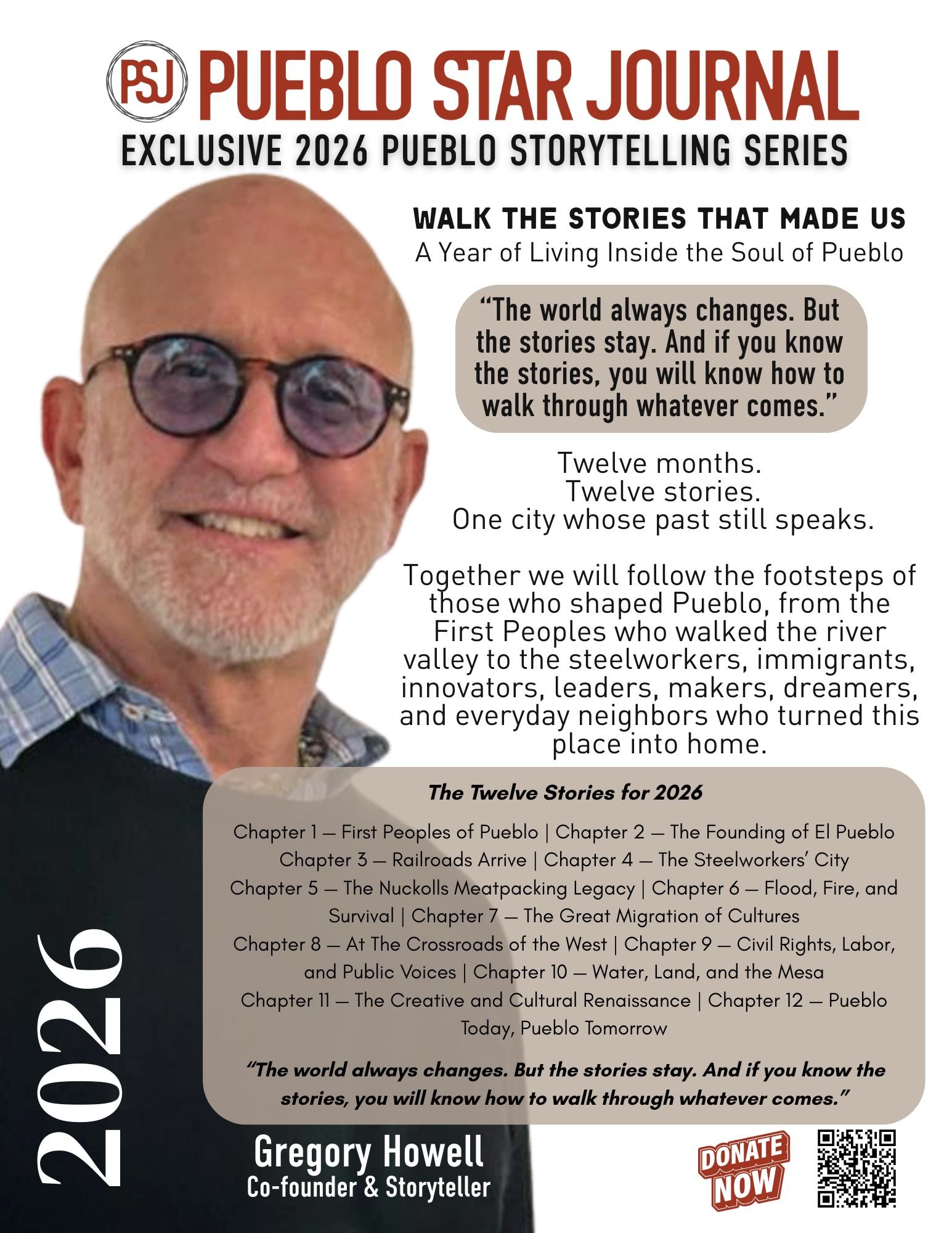
The flyer for the 2026 series calls this “Walking the stories that made us” GH 2026 12 CHAPTER PUEBLO STORY…. That phrase matters to me. These are not abstract histories. They are footsteps. Decisions. Turning points.

And we are still walking.

The North Star

Every chapter carries the same thread:

When we listen and remember the stories, we will be prepared for whatever comes.

Preparation does not mean control. It means awareness. It means humility. It means understanding that borders are rarely lines — they are collisions of stories.

Pueblo has lived through borderlands, industry booms, economic collapse, natural disaster, civic reinvention, and cultural renaissance. We are still evolving.

This series is not about proving anything.
It is about listening long enough to recognize ourselves.

An Ongoing Conversation

Each chapter will be released monthly. Each one will stand on its own. Together, they form a year inside the soul of Pueblo.

If you choose to follow along, I invite you to do more than read.

Ask your elders what they remember.
Walk the river.
Stand in places where something once began.
Listen.

Because the world will continue to change.

But if we know the stories, we will know how to walk through whatever comes.
Gregory Howell

A Panel Discussion on Gentrification in Colorado with the Colorado Association of Realtors

This is the full recording of the Colorado Association of Realtors Webinar on Gentrification in Colorado: Changing Neighborhoods. Recorded Wednesday, July 13, 2021.

Adaptive reuse is the process of repurposing buildings for viable new uses and modern functions, other than those originally intended to address present-day needs. Reuse allows for a building's continued use and helps it remain a viable community asset. Adaptive reuse is important for a community because it: Maintains cultural heritage. In communities with historic architecture, adaptive reuse is a form of historic preservation. It restores culturally significant sites that would otherwise be left to decay or demolished to make room for new buildings or parking lots.


Watertower Place (Nuckolls Packing Co 1917) located in the historic Grove Neighborhood in Pueblo, Colorado.

Watertower Place (Nuckolls Packing Co 1917) located in the historic Grove Neighborhood in Pueblo, Colorado.

Future home of Fuel & Iron (formerly Holmes Hardware and built in 1915) located in the Union Avenue Historic District, Pueblo, Colorado.

Future home of Fuel & Iron (formerly Holmes Hardware and built in 1915) located in the Union Avenue Historic District, Pueblo, Colorado.

Keating Junior High School (1927) located in Pueblo, Colorado was recently added to the National Register of Historic Places and is in the process of creating a new mix-use development with residential units on the second floor and commercial and retail establishments on the first floor of the former school.

Keating Junior High School (1927) located in Pueblo, Colorado was recently added to the National Register of Historic Places and is in the process of creating a new mix-use development with residential units on the second floor and commercial and retail establishments on the first floor of the former school.

National Trust for Historic Preservation

ReUrbanism (city scale preservation) positions preservation in the larger context of human needs. We know preservation is an element in livable, vibrant, equitable, and creative communities. Preservation provides character and identity, contributes to sustainability and walkability, fosters a sound economy, spurs creativity, and gives people the psychological and sociological sense of stability they need in an ever-changing world. Yet, while the preservation of our older and historic places is critically important to a community, it is only one part of the various elements that make a community livable and vibrant. Through ReUrbanism, preservation seeks to work in tandem with and support the many other fields that contribute to livable and vibrant communities, including planning, natural conservation, economic development, health and welfare, social justice, and sustainability.

Best Practices & Policies Moving Forward - Marginalized Communities

With this broader reach in mind, preservation that focuses on people is essential: it is dinner, not dessert. Reuse becomes the default option. Reinvesting, reusing, reinventing, recycling, and reinforcing our existing communities is livable and sustainable. To guide this work, the National Trust has identified 10 principles of ReUrbanism:

  1. Cities are only successful when they work for everyone. People are at the center of our work. Preservation projects can create opportunities for community residents at all income levels to live, work, and play in a diverse and thriving environment.

  2. Older places provide the distinctiveness and character that engender success. Older buildings give cities a sense of identity, history, and authenticity—which is the most important competitive advantage they can have in today’s economy.

  3. Older neighborhoods are economic engines. Research shows that neighborhoods with a mix of older and newer buildings perform better along a number of social, economic, cultural, and environmental metrics than areas with only new buildings.

  4. New ideas, and the New Economy, thrive in older buildings. All over America, the most innovative companies of the 21st century are choosing to make their homes in older buildings. These buildings fuel creativity by being distinctive, character rich, endlessly adaptable, and often low cost.

  5. Preservation is adaptive reuse. Adaptive reuse is preservation. Historic preservation is not just about keeping old buildings around. It is about keeping them alive, in active use, and relevant to the needs of the people who surround them.

  6. Preservation is about managing change. Healthy, dynamic neighborhoods are always in the process of change. Historic preservation is about managing change: unleashing the enormous potential of older buildings to improve health, affordability, prosperity, and well-being.

  7. Cities are for people, not vehicles. Reclaiming city streets and making them more amenable to pedestrian and mass transit use can help neighborhoods reacquire activity and thrive once more.

  8. The greenest building is the one that’s already built. It takes energy to construct a new building—it saves energy to preserve an old one. It simply does not make sense to recycle cans and newspapers and not recycle buildings.

  9. There are many ways to achieve density. Areas with a mix of older and newer fabric tend to be denser than new-only neighborhoods, and they achieve that density at a human scale.

  10. Every community has stories and places that matter. The places worth saving are those where communities choose to come together and that represent the local stories they treasure and wish to see preserved.

As the stories began to unfold during our research on the meat packing plant, it became evident that we needed to honor and celebrate those before who contributed greatly to the success of the plant and to the local community. These storyboards are three feet in width and six feet in height and hang in the first floor corridor adjacent to the front receiving docks and Johnny’s Boiler Shop.

As the stories began to unfold during our research on the meat packing plant, it became evident that we needed to honor and celebrate those before who contributed greatly to the success of the plant and to the local community. These storyboards are three feet in width and six feet in height and hang in the first floor corridor adjacent to the front receiving docks and Johnny’s Boiler Shop.

 
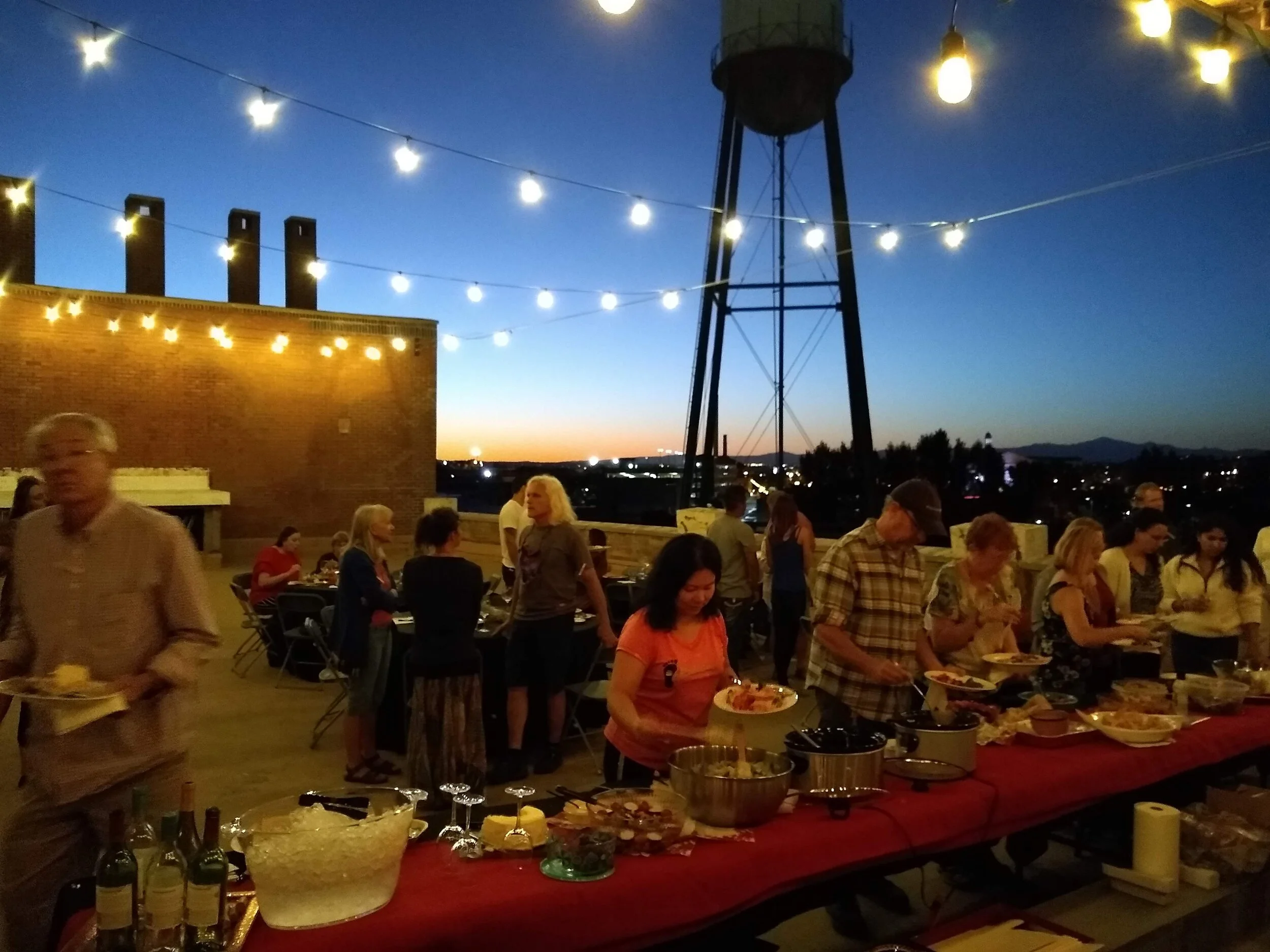
The National Wholistic Health Alliance enjoys a sunset potluck dinner on the Upper Riverwalk Terrace (4F) overlooking downtown Pueblo, the Riverwalk, and majestic Pikes Peak in the distant background.

The National Wholistic Health Alliance enjoys a sunset potluck dinner on the Upper Riverwalk Terrace (4F) overlooking downtown Pueblo, the Riverwalk, and majestic Pikes Peak in the distant background.

Pueblo Mayor Gradisar Visiting Watertower Place with Staff and Friends

Pueblo Mayor Gradisar Visiting Watertower Place with Staff and Friends

Participants on a Watertower Place Tour enjoy seeing and discussing the floor plans for the former meat packing plant.

Participants on a Watertower Place Tour enjoy seeing and discussing the floor plans for the former meat packing plant.

 
WP Center Innovation & Entrepreneurship 36'x72' .png
WTP Food Entrepreneurship 36'x72' Food Entrepreneurship.png
WTP Small Batch Manufacturing 36'x72' Small Batch Manufacturing.png


Historical Context Reports

Making Sound Preservation Decisions

EASTSIDE.png
 
bessemer.png

Acting upon the inertia of the context’s emerging success, even in the draft stages, the City of Pueblo immediately proposed to intensively survey 45 properties in the East Side Neighborhood area. Again the City applied for a CLG grant, which it received in January 2009. And again it contracted Historitecture to conduct the survey, the results of which are presented in the Pueblo East Side Architectural and Historical Selective Inventory Report.


The major goal of this project was to acquire as much architectural and historical data as possible for 43 selected properties in the East Side study area (Historitecture actually surveyed 45), allowing city staff and others to make sound preservation planning decisions regarding this neighborhood.

Study Outcome

Read this short overview of the East Side Historic Building Inventory Study's outcome to learn more about how the project helped 16 buildings become eligible for the National Register of Historic Places.